Showing posts with label barbed wire. Show all posts

Friday, December 19, 2014

Darn Those Russians!


Friday December 19 2014

Salsola tragus, aka “Russian Thistle,” or Tumbleweed, is as ubiquitous in the West as barbed wire, and coincidentally the two go together like peanut butter and chocolate.

A native in the Ural Mountains in Russia, the plant seeds snuck over on ships in the late 1800’s from Russia apparently hiding amongst flax seeds, showing up first in South Dakota, and tumbling all over the West thereafter. While “Tumbleweed” aptly describes the entire plant’s existence and planetary purpose, I am also fond of the honorific “Wind witch”.

The tumbleweed is an annual plant that, once it matures, dries out and dies, breaks off at the base of the stem and tumbles away in the wind, efficiently flinging and dispersing its seeds along the way to take root in your soils, and then to ultimately shore up your barbed wire fences. (See Steph’s accurate cartoon depiction of tumbleweeds here)
and my short video of me running the gauntlet of them on an Idaho highway on a windy day!:


(or link)
http://youtu.be/t1AfB6Lam3w

Once the desert soil out here is disturbed - that is, as soon as you plow it up thinking you’ll have a fantastic self-sufficient green pasture, or, after a flash flood that scours the sand, or almost immediately after a burnishing wildfire, Russian thistle will be the first plant to move in and take hold. On the plus side, they are pretty - turning maroon in the fall; and if you didn’t have the tumbleweeds, you’d soon have sand dunes developing. But on the downside, they spread, and spread, and are virtually indestructible. One winter I uprooted a whole plot of them and tried to set fire to them - they wouldn’t burn! (Oh, but they will burn quickly when they are dried.) And they are sticker-y as hell.

Before I became more than casually acquainted with tumbleweeds, I thought I’d gather one to send to my artistic sister, who I was sure could make some spectacular work of art out of it. After I collected a handful of painful stickers trying to stuff one in a box, she also found a handful of stickers when she opened the box and tried to remove it; and she decided not to use it. “They are not the cute tumbly little things bouncing across the road. They are very pokey.” Now I know to wear gloves when I have to wrangle with tumbleweeds.

Out of all the tumbleweeds everywhere, this particular one caught my eye. It was a large one, hanging out with a barbed wire fence. It was so impressive, I thought I’d drag it home. The horses were impressed in different ways - not at the tumbleweed, but me, a human, dragging it behind me!


Sunny and Jose are alarmed


Stormy is not bothered.


Batman is bored


Dudley is (no surprise) hungry! He’s actually picking it up to pull off a prickly stem!

Saturday, March 29, 2014

Fence 'Em Out


Saturday March 29 2014

Idaho is a state with "Open Range Laws", meaning livestock has the right of way. Cows wander in and scare your horses off and eat your hay? Too bad, you have to fence them out. Bull charges you out in the open? Too bad, he has the right of way. You hit a cow out on the highway? Too bad, you are liable and you get to pay for your car damage and reimburse the rancher. (We know to drive very carefully on the highways in the winters and springs here.)

The property owner has to fence unwanted livestock out. (Idaho Code apparently allows counties to create "herd districts" where the animal's owner is liable for any damage it causes, but I expect there aren't many herd districts in the state; and anyway, land previously used as open range can't become a herd district.)

There are plenty of twists and turns within this law (such as, what defines a "lawful fence"), but the basic law is, if you don't want the cows on your property, you have to maintain the fencing to keep them out.

We get the occasional cow or two or three every year up our canyon that we drive on out (although if it's a bull, we call the ranchers to come get their bulls! We don't mess with bulls), but this year, many, many cows can't resist our green grass and the delightful bubbling crick up the canyon. 

This winter, we're doing a lot of moving cows out, and we're doing a lot of fencing 'em out. Hammering the little U-nail-jobbers is good hand-eye coordination practice for some people (ahem), and besides, driving cows is excellent cross-training for the endurance horses, some of whom are afraid of cows. 

It's just part of life in the West!


Wednesday, February 8, 2012

You've Come a Long Way Baby


Baby!

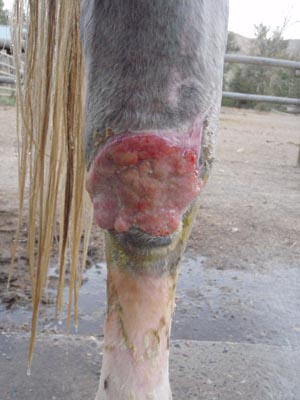
From this (on July 18 2011)

to this (today)

and this

Sunny has made it a long way from her dreadful barbed wire injury last year.

She never was the worse for wear, never did take a lame step. The injury only hurt the first few times we changed the bandage, but even before tissue completely grew over the exposed bone, she took no more notice of it.

She'll be ready for an endurance ride by summer. Maybe even spring. I'm thinking John should even do a 100 miler on her at the end of May. (Haven't told John that yet).

Tuesday, January 10, 2012

Back in Business


 Tuesday January 10 2012

From the top photo on July 19 (that photo is Day 9)

to this (5 months and 23 days later):

and this:

Sunny is back to work after her horrific barbed wire accident. Miraculously, she never did take a lame step, and she rather kept herself in shape while she was penned up, spending her days pacing and sometimes sprinting along her fence, until she was turned out beginning of October.

She's a little uh… fat now, and despite her being sound, I'm not doing much with her. Just a little work at a time. But she'll be ready for an endurance ride this summer. John will be back on his favorite mare. 

Jose is supervising the progress.

Sunday, December 11, 2011

Just About Gone


Sunday December 11 2011

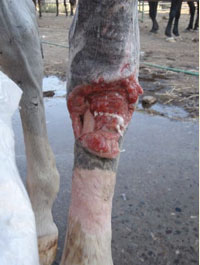
Remember Sunny's dreadful barbed wire accident back on July 18? (The photo above is from the first bandage change, 9 days afterwards.

After about 2 1/2 months of bandaging, we left it open and turned her out - as it was getting increasingly hard to keep a bandage up over the hock, with all her sprinting back and forth in her pen! The vet said it would be fine to turn her out, and we did.

Without a bandage, the wound was slower to heal though it continued to do so. I hosed it every day or every other day and usually put Shreiner's spray on it, and covered that with aluminum spray as a 'bandage' to keep the flies off.

Around that time, her lower leg swelled to about the size of a draft horse leg, from the hock on down. It stayed that way for a month or so, but she was never lame on it, and the vet was unconcerned.

There was some proud flesh persisting on the inside of the wound, so I switched from the Shreiner's to a sulfadine cream (the vet gave us two kinds: one for healing a wound and one for preventing proud flesh). I put the anti-proud flesh cream on just that area, and the healing cream on the other part. The vet thought he might have to remove some of the proud flesh - but it want away on its own with the cream.

This blog entry here shows the progress through October.


Now the water hoses are frozen, so the wound doesn't get hosed often - but it's still healing. This last photo is 21 weeks after the injury, almost 5 months later. It's only about 1 1/2 inches tall by 3 inches wide, and pretty much a surface wound now.

Amazingly, it's almost all healed up. Never would've imagined it.

Monday, October 17, 2011

Sunny - The Barbed Wire Injury


Monday October 17 2011

This is an update on Sunny's continued healing from her July 18th hind leg barbed wire accident.

If you want to review the whole healing progress, see Aug 14 Amazing Healing and Sept 9 The Healing Continues.

She'd continued to stay penned up and bandaged since then. She did have Perry, the other gray mare, for a companion, till the one day I found Sunny cornering Perry in the corner and kicking the bejeezus out of her. (The nerve of Sunny, doing that to her babysitter, without which she'd probably have killed herself for lack of companionship!)

I moved Perry into a pen right next to Sunny, which was just fine with Sunny, because it gave her more room to really work out hard - wind sprints across her pen, short gallops and spins and rears on her hind leg (to get the most efficient change of direction), much of which involved banging one of her 4 legs on the fence panels - etc. I managed to keep the bandage from slipping down for 3-5 days at a time despite her acrobatics; I'd remove it and leave it open for a day, spraying the silver alum spray on, then re-bandaging her the next day. (Closing of the wound is much faster with a bandage on.)

Our vet looked at her at the end of our 5-day Owyhee Canyonlands endurance ride on October 1 and was rather astounded at how well and how fast it's healed. He thought it might require a little proud flesh removal (on the inside bottom corner of the wound) at a later date, but in the meantime, he said, "Turn her out!" If I could keep a bandage on her, fine, and if I couldn't, that was fine.

Sunny was so relieved to be turned out with the herd (even though they were often standing 30 yards away from her). Despite the much-less moving around, her bandage slipped down after 2 days, so I've left her unbandaged since (11 days so far).

The wound continued to heal - I hosed it off every day for 10-15 minutes (strong hose pressure), and dried it off and then sprayed it either with Schreiners Herbal solution (supposed to help with proud flesh, of which she still has a small lump on the lower inside of the wound) or the Alum spray (which as far as I can tell is just a protectant seal, not a medicine).

(Top photo is July 27, Day 9)

Sept 13-Day 57


Sept 21- Day 65


Sept 26 - Day 70
(the wound is actually a little smaller - it's just a closer shot, I should have kept the camera at a consistent distance for all of these. I'll know next time although I hope there is NEVER a next time. Note that there is a little more proud flesh to the inside of the wound.)


Oct 5 - Day 79 (left unbandaged after this)


Oct 14 - Day 88 - a week without bandaging


Then, Friday of last week, I noticed her leg was a bit swollen, from below the wound on down to her ankle. Saturday it was worse. Definite swelling, from the hock behind the wound to the ankle. You can see the difference in the size of the left lower leg and hock in the photo just above.

Damn! What was it - did she get kicked? Jam it somehow? Was she suddenly standing around too much at the hay bale with the herd after 2+ months of self-imposed conditioning in her pen? Did the hock suddenly become infected? How could the joint be infected now, after almost 3 months?? (The wound had healed from the inside out, quite cleanly.) That would be dreaded news if that was true. She still was not lame on it, which was a very good thing.

The vet was out on Sunday, and he took one look at it - and was astounded again at the progress of the healing. Even the proud flesh has decreased. "But what about the swelling?" I asked.

"Don't worry about it. Sometimes tissues just restructure themselves as they heal. She's fine. Keep doing exactly what you're doing."

What a relief! We had fears, but didn't want to voice them, about All That Work fixing her up, and she's doomed anyway.

But she's not!

In fact, John's probably going to start riding her again soon. (Might as well, since she's kept herself conditioned through all this.)

: )

Friday, September 9, 2011

Sunny: The Healing Continues


Friday September 9 2011

We've been following Sunny's healing from her hind leg's battle with barbed wire on July 18.

I did an update through August 13 (Day #26), Amazing Healing.

The following is her steady progress since then. The pain has gone away and in fact, she spends a lot of time pacing and/or running her pen when the herd has left (she doesn't care about Perry, who's babysitting her - and in fact I had to move Perry to her own pen this week when I heard, then saw, Sunny outright attacking her!). Which has led to the latest problem: her sore hock. The bandage starts slipping down, and the wraps above the hock become tight, and have started cutting into the skin right above the top of the hock, and leaving the point of the hock swollen.

Last night for the first time, since the wound is looking so good (it's about half the original size now), I left her unbandaged. I figured it would be cool enough overnight that the flies would leave it alone. I hosed it a long time with water, dried it off and sprayed Shriner's spray on it, and a coating of fly spray. This morning I rewrapped it. I'll probably keep doing that - leave the wrap on 3-4 days, then leave it off a night. We'll have Dr Washington out to look at it one of these days... she still may need that lower flap of skin, and some proud flesh removed, but overall, she continues to heal marvelously and at an amazing pace - and still no sign of lameness.

Day 28:


Day 30:


Day 33:


Day 37:


Day 40 (see the bandage cuts above the hock and the swollen cap of the hock):


Day 42:


Day 47:


(today) Day 52:


Tuesday, July 26, 2011

Return of the Walking Wounded


Monday July 25 2011

Sunny's back!

After 7 days at the vet, she's back home after her battle with barbed wire.

Prognosis is good - although it will be a long convalescence: another week of oral antibiotics, and 4-6 months of bandaging. Yikes!

The vets don't think the wound reached the joint capsule and they don't think it's infected (which would be the best news) - though that could still happen and it could show up much later. A couple of inches of cannon bone are still exposed.


She's not lame on the leg (which is also the best news) and the vet says she could make a full recovery.

We'll change the bandage first time tomorrow - if they aren't too gory, pix should be available! We'll all be bandaging experts for sure by the time she's healed completely.

The Owyhee herd is glad to see Sunny again, and John's pretty happy to have his favorite mare back.

Monday, July 25, 2011

Cottonmouth


Monday July 18 2011

As we're driving up Bates Creek, getting home from the Big Horn endurance ride, we're discussing the possibility of a new endurance ride at the City of Rocks that we've just toured, talking about who we'll ride around here tomorrow.

John has called and said he was going up the canyon to fetch the horses since he hadn't seen them yet today.

I'm thinking of feeding Rhett (who's been calling for his dinner every night I've been gone), hugging Jose, and smooching on Stormy.

I jump out of the car with my cameras and wait for the horses to come thundering down to the house in the golden evening light for some fabulous back-home photos... but the only dust I see is John on the ATV.

His face is sober when he arrives.

"The horses are way up the canyon. Sunny's cut her leg bad and Jose's on the other side of the fence." He looks sick.

I feel sick.

John heads for the truck and trailer. Steph heads for the ATV. I grab 3 halters and climb on the ATV with her.

Up the canyon we go, hot wind drying my mouth, bumpy road setting my stomach to churning.

A quarter mile from the end of the canyon, there is the herd. Jose is standing by himself on the other side of the barbed wire fence. Sunny is standing off by herself well away from the fence, but well away from the herd. Steph and I climb off the ATV. She heads to Sunny. I head for Jose.

I can see two old thick fence posts half laying down, 4 strands of barbed wire detached in places and hanging at 4 different dimensions. Somebody had a battle with that barbed wire fence and lost. I feel nauseous. My legs are shaking. I might cry. Please God, not Jose too. I have cottonmouth, tongue stuck to the roof of my mouth, throat painfully dry and cracked.


I first come across my horse Stormy. Stormy knows barbed wire - he once got into it badly enough to spend 8 days at the vet. Thank God he is fine this time.

I get to the fence and Jose next, dreading what I will see, but miraculously, a quick glance tells me he is fine, with not a mark on him. My hands are shaking as I put his halter on and I give him a quick hug. I can't speak to him because my mouth and throat are so parched, but I know he knows how relieved, how grateful I am.

As I start leading him up the canyon to the nearest gate back into the acres with the rest of the herd, we pass closer to Sunny. I can only see her upper legs for the tall sagebrush but there is dried blood and cuts up there. She must have been standing there a long time, maybe all day. I can't see the worst of it, but Steph just says, "It's bad." I almost cry.

I lead Jose back in with the herd. i walk up to Steph and Sunny, wishing time backward, wishing this hadn't happened.

It's bad. Huge gaping gash on the inside front of the left hock. It looks a lot like Finneas' leg when he tried to tear his hind leg off on a fence 4 years ago - only much worse.

John has followed us in the truck and trailer. With Steph leading, and me insisting from behind, we get Sunny loaded in the trailer. Steph and John drive her to the clinic 90 minutes away.


Many hours later, after midnight, they return with an empty trailer. They've left her at the vet. We'll know in the morning if the gash avoided the joint capsule and if it avoided infection. We'll know if she'll make it.

The herd follows the horse trailer back to the house. As Sunny leaves for the vet, I take Jose out to feed him. I give him a fierce hug. I look him in the eye, and I tell him thank you for not getting hurt. He listens, and I know he understands me. I hug Jose, I bury my head in his mane, I hug him, I hug him, and I don't let go for a long while.

Sunday, January 10, 2010

Barbed Wire: Bane and Boon of the West


Sunday January 10 1010

It's such a common sight in the West that it's hardly noticed: barbed wire. It's as much a part of the landscape as the sagebrush and the Owyhee mountains here. It wasn't always so.

Just about in tandem with the Owyhee gold rush in the 1860's, cattle became another source of gold in this region of the Snake River drainage with its rich grasslands.

Cattle were driven up from California and Oregon, and from Texas. Con Shea drove the first thousand-head herd up from Texas to Idaho in 1867, turning them loose here near Oreana for the winter. He found it so profitable he made it an annual excursion, despite the hardships, the rugged terrain, and the risk of Indian attacks.

Cattlemen ruled the rangelands in the 1870's, turning their herds loose around here to graze wherever they could find food; but by the next decade, homesteaders were competing for some of that land.

People started getting territorial. Ranchers wanted fences to keep out farmers and homesteaders; farmers wanted to keep cattle from trampling and eating their crops; ranchers wanted to keep other ranchers out when the feed was scarce.

Brush, wood, and stone fences were impractical and didn't work to hold cattle, and smooth wire didn't keep them in. Wire with barbs on it did. Though he wasn't the first to design a wire with sharp points affixed to it, Joseph Glidden of Illinois in 1874 invented and patented the barbed wire like we see today.


It worked so well that the Fence Cutter Wars erupted between those wanting to keep cattle off their lands (or, not necessarily their lands, but the lands they fenced), and those free-range ranchers who thought their cattle should be allowed to wander and graze at will. Some of the skirmishes became so violent, and ended in enough deaths that fence cutting became a felony in some states.

Since the ubiquitous cattle still roam the West, on private and public lands, the barbed wire still rules. It might not be the best fencing for horses, but then a horse will find a way to kill himself in fencing made of feathers, if he sets his mind to it. Finneas about sliced his hind leg off two winters ago on smooth wire.

It's good hard work to put up barbed wire fences properly - and it's work taking them out. Count on sore hand muscles even if you do have bolt cutters, sore arm muscles from carrying the rolls of barbed wire out,
and count on a permanent scar or two as souvenirs of the wild West. I've got one on my arm from 1998 from opening a cantankerous barbed wire fence gate.

I finally hiked up and pulled out a downed fence up the canyon that has been worrying me for two years now. A stretch of fence was undercut by a deep and newly-widened gully from a flashflood, and part of it was hanging over the edge of the gully and part of it was laying down. If a horse slipped and fell in there through the fence. . . better not to think about it and just get it out of there. I thought normally the horses didn't go up by that fence, but sure enough, as I was working on it, I found a pile of horse poop right by it. I wrestled with the rotted and downed wooden posts and metal T-posts, and wrangled with untangling and rolling up the 4 strands of wire.

I just can't be brought to throw away this genuine Owyhee barbed wire - and though it is thoroughly AGGRAVATING and ANNOYING to work with it, it makes some nice Owyhee Western decorations.

This one looks like Jose, don't you think? : )