Showing posts with label petroglyphs. Show all posts

Wednesday, May 22, 2013

Snake River Petroglyphs


May 22 2013


Some 32,000 years ago, Lake Bonneville formed, covering most of northwestern Utah (the Great Salt Lake is a remnant). About 15,000 years ago, it broke out of its natural dam near present-day Pocatello Idaho, creating the Bonneville Flood - possibly the second largest ever on the planet. For 8 weeks it flooded out at maximum, carving canyons and falls, ripping out huge, car-sized boulders from canyon walls, and depositing them along the river.

Today, geologists call these big boulders "melon gravel" because of their resemblance to big watermelons. Rolled and smoothed and polished and tossed around by the great powerful floodwaters, some of these boulders became canvases for Native American art.

By 12,000 years ago, humans were living on the Snake River Plain. (The earliest evidence from a cave near Dietrich, Idaho, are tool flakes and a basalt knife 14,500 years old.) The petroglyphs carved on many of the tens of thousands of boulders along the Snake are evidence of their early habitation. Many petroglyphs are probably from the Early Archaic (5000 to 7800 years ago) and Middle Archaic periods (1000-5000 years ago), though most are from the Late Archaic period (340 to 1000 years ago). Many of the petroglyphs along the Snake resemble Shoshone Indian art found in California and Nevada.


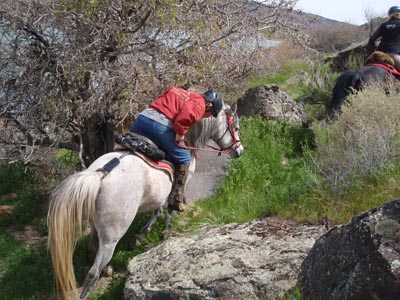
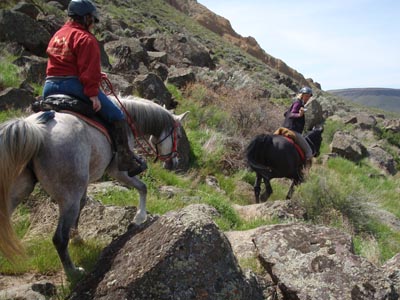
The Snake River petroglyphs can be accessed by following a maze of dirt roads, or knowing where the locals access trails. We used a shortcut starting up on the flats, taking a steep cliff trail down to the river basin.


Petroglyphs are scattered on boulders for miles along the Snake River (you might be interested in the book Understanding Meaning and Purpose of Rock Art, by D Russel Micnhimer).

 
On the north side of the Snake a couple of miles upstream from where we rode is Celebration Park, Idaho's only archaeological park. On the south side, downstream on BLM land, a large collection of the rock art is grouped together, and is well-preserved, likely because of its non-advertised, not-so-easily accessible location.


We looped through the art gallery, both horses and humans contemplating the meaning of the art, and wondering about the people behind the imaginations that created it so long ago.

[slide show here]


or link:
https://picasaweb.google.com/TheEquestrianVagabond/SnakeRiverPetroglyphs5202013


Friday, June 3, 2011

Owyhee Fandango Day 3: Fly


Sunday May 29 2011

70% chance of showers, and yet there is not a cloud in the blue sky, as we saddle up again for an 8 AM start - Jose and me and The Raven, for Day 3 of the Owyhee Fandango, 60 miles, to the Petroglyphs by the Snake River and back.


The wind is chilly and brisk as an autumn day as we head out to the northeast, with John and Rushcreek Mac, and Ben and Batman in our wake. Clouds have already blown over some of the Owhyee mountain peaks, but the lighting is brilliant, making the blue sky brighter and the Owyhee mountains darker and the wildflowers vibrant. It is great to be alive today and riding Jose on another endurance ride in the Wild West. Jose feels as fresh as he did when I saddled him yesterday morning.


We cross the highway where the radio guys and gals take our numbers, and we continue on toward the Snake River. A sheet of tiny golden flowers covers the lower reaches of the Badlandic striated hills that overlook the Oregon Trail. We turn with the wind and follow the old trail, our hoofsteps blending with those of horses and mules from 150 years ago.

After 14 miles and two hours we arrive at the Sierra del Rio ranch - through which the Oregon trail travels - and we have a 30 minute vet check. The ranch had originally closed it to us because of the EHV-1 virus going around - and one can understand a working ranch doing such a thing - but after talking with our head veterinarian Robert Washington, they changed their mind, and generously let us not only pass through their ranch but use one of their lush grassy fields for our vet checks. The horses loved it - they almost passed up their dishes of grain for the green grass. The Ranch even set out a couple of big water troughs for the horses to drink out of.


At the ranch, some of the 80 and 100 milers are resting at their second vet check. They'd already done a 20 mile loop and a vet check at home before heading out here. From here, the LD riders turn around to ride home; the rest of the distances, 100, 80, and 60 milers, do an out-and-back loop to the petroglyph boulders along the Snake River.


Annerose asks to join us. She fell off her horse at 7 miles - fell hard onto the road when Ginger spooked at a tumbleweed. Annerose hurt, among other things, her back and her hand and maybe her kidney - and she got back on and continued to ride. Annerose is 73. Yesterday she reached 11,000 endurance miles. She's the only one who, if she finishes, will have completed all 3 days on the same horse. And Ginger will be 10 miles away from 6000 miles. Annerose is tough. And stubborn. "My father comes form Westphalia in Germany," she says in her still-heavy-German-accented English, "and they are known as the most stubborn people. I guess that's where I got it from."

After our hold the four of us mount up and climb out of the canyon on the old Oregon Trail wagon road up onto the flats, straight into the wind. I hate the wind, but today, it doesn't bother me. It sure doesn't bother Jose - he charges right into it, ears pricked forward, setting a strong and steady trot and seeming to know exactly where he is going. He doesn't try to take the shortcuts home - he's working today and he knows his job. I swear the horse is following the pink ribbons on his own.


We get our first glimpse of the Snake River Canyon on the rim - we will be riding down into that canyon soon.

The only time Jose consents to stop is when everyone else behind him has stopped (especially Mac) to eat some of the delicious bunch grass below Sinker Butte. Mac is intent on gaining weight during this ride.

Our trail follows the base of Sinker Butte before turning onto the road that leads down, down, down to the Snake. Jose and Ginger lose Mac and Batman to the knee-high grass lining the road. It invites gluttony, and Jose stuffs as much grass as he can in his mouth while waiting for his trail partners.


We trot alongside the Snake for many miles, the flood-water-carved cliffs lining the way and the cacophony of birdsong harmonizing with the wind blasting in our ears. There is an abundance of waterfowl and grassland birds; raptors inhabit cliff nests; cliff swallows swarm in places; and a big Disappointment of Ravens (that's what a group of Ravens is called... but they are never disappointing!) cavort in the wind gusts. My riding Raven is, as always, enjoying his cavort with Jose.


We meet riders on the out-and-back trail: Jennifer and mother Joyce, leading the 100-miler, with Lee Pearce, leading the 60 miler. We meet Steph and our stablemate Rhett, who freezes like a statue when he sees us coming at him. He is terribly disappointed that he must continue on without us, and while our horses continue on their business toward the petroglyphs, Rhett's pathetic whinnies can be heard echoing up and down the canyon.


Steph has flagged a fun loop through the petroglyph boulders, I've never seen so many of them because we usually only ride a trail past only 3 or 4 of the carved boulders. When Lake Bonneville in the Great Salt Lake, Utah, area breached its natural dam 14,000 years ago, its waters tore down the Snake River, slicing gorges, stripping sediments and debris, and throwing "melon gravel" about - huge, car-sized boulders so named because of their resemblance to big watermelons. Rolled and smoothed and polished and tossed around by the great powerful floodwaters, the boulders now litter various places along the river, planted in limbo until the next Great Flood comes to move forcibly evict them to their new homes.

Some of these boulders served as art canvases for the Native Americans that wintered along the Snake - some of the petroglyphs have been dated back 11,000 years. Their meanings are still unclear, but the art is unmistakable.


We turn and retrace our steps back along the same trail, the wind at our backs, the scenery completely different. There even seems to be less rock underfoot in this direction. We fly along, and soon we are back at the long uphill climb out of the canyon.

The wind is still going full blast up on the flats. The trails have become dusty now. Through half-closed eyes, we stop to eat more of the bunch grass along the way. We follow the same Oregon Trail with its century-and-a-half old wagon ruts, back down to the Sierra del Rio ranch for our hour hold.


We rest in the sun - Annerose is tired and hurting now - but still stubborn. We only have 14 miles to go, and she wouldn't quit now if she had to walk in on foot.


Annerose and I pair off, leaving John and Ben to ride together. Batman has become such a handful for Ben that Ben broke a rein trying to hold him back. We figure Batman'll be calmer with one other horse on the way home, instead of 3 to compete with.


Dark storm clouds have gathered over the Owhyees and lay directly between us and home. Neither Annerose nor I are capable of hearing thunder unless it's right upon us, and to me those clouds look a bit suspicious. By the time we cross the highway, with 6 miles left to home, I am getting a little nervous. When Annerose says, "That looks dangerous," that settles it! We've been trotting, and now we trot and canter, fast, for 5 miles without stopping. I'm hoping Annerose is staying on behind me because I do not want to stop.

I am half scared and half enchanted with this storm (my camera battery has died). Jose and I are hurtling down the road, heading straight into a black wall of low clouds. We are intent upon getting to the Bates Creek Rim, down off this flat, out of this storm cloud we are staring down.


I marvel at Jose's limitless strength - his hundredth mile is like his first. I cannot believe this horse has gone almost 110 miles in the last two days, so eagerly and easily. Rain drenches the desert, horses and riders. Jose bows his head against the spitting raindrops, but does not skip a beat, as we soar into the black cloud. My horse flies without wings. His hooves lightly skim the earth, he swiftly moves unfalteringly forward, not in a race to get home, but to dance in the Owyhee storm.

Tuesday, April 27, 2010

The Whiskey Traverse


Tuesday April 27 2010

Beginning humbly in western Wyoming at 9500' as a little river running into Jackson Lake, the Snake River loops through the southern part of Idaho before emptying into the Columbia River in Washington.

When Lake Bonneville in the Great Salt Lake, Utah area breached its natural dam 14,000 years ago, its waters tore down the Snake River, slicing gorges, stripping sediments and debris, and throwing "melon gravel" about - huge, car-sized boulders so named because of their resemblance to big watermelons. Rolled and smoothed and polished and tossed around by the great powerful floodwaters, the boulders now litter various places along the river, planted in limbo until the next Great Flood comes to move forcibly evict them to their new homes.

Some of them served as art canvases for the Native Americans that wintered along the Snake - some of the petroglyphs have been dated back 11,000 years. The Snake escorted Lewis and Clark's expedition along for 6 days in October of 1805; it became a major water source for an estimated 400,000 pioneers that used the nearby Oregon Trail in the 1840's to 1860's.

Today the Snake shadowed us on our mission: the Whiskey Traverse through a 'melon gravel' field along the Snake River, to find a connector trail between Celebration park and the Petroglyphs Trail we follow on some of the Owyhee endurance rides.

It's called the "Whiskey Traverse" because Tom Noll and his Owyhee mustang Whiskey first followed the footpath on horseback (well... they probably weren't the first, but they were the first to convince Steph a loop could be made for an Owyhee endurance ride).

The spring flowers were in riotous bloom, and the grass mid-cannon-bone high (i.e., high enough to grab the horses' noses) along the river as we made our way along a trail below the classic Snake River cliffs and buttes. The Snake was flowing wide and fast, and Jose was not so sure about it. In fact he was really uneasy about it the whole ride, eyeballing the rapids and deeper pools suspiciously from above and staying very close to Batman and Suz, and often getting goosed from behind.

Entering the boulder field, our horses twisted and turned and wove their way along a faint path. Some places were overgrown by tree branches and we had to flatten ourselves over our horses' necks; one part of the path was choked with thick willows and tumbleweeds that our horses bulled their way blindly through. When the going became questionable, Steph got off to scout the trail ahead on foot, while Carol and I and the three horses waited and got a taste of what it would be like to be eaten alive by buffalo gnats. They weren't bad when you were moving, but stop and you had a blinking "Fresh Meat!" sign on you.

Steph was gone scouting long enough we thought she might have jumped in the Snake and ended up in the Columbia 314 miles downriver, (Jose was looking for her), and long enough for half our blood supplies to be drained, and long enough for all the grass in the surrounding area to be eaten down to the bone by grass-starved horses (they hadn't had any grass in a couple of hours).

When scoutmaster Steph returned in one piece we mounted and rode boldly onward through the boulders, with only a few places being a bit sketchy, where the horses had to carefully look and think before placing all four feet, or step up onto a slab before picking their way over a spot, or (like superhero Batman) artfully balance on their hind legs and pick a spot to place his front feet. It brought to my mind the regular trails I always rode our pack string over when I packed for the Forest Service in the Sierras, and never thought twice about. My sure-footed steed Jose did make me think how lucky I was to not be driving a wagon through here back in 1860 and realize I took the wrong path and have to find a place to turn it around.

We successfully emerged from the other end of the half mile of melon gravel (I like that label), and connected up with the Petroglyph trail. Looks like this loop could be part of the Fandango ride.


We turned around and retraced our steps through the boulders, then rode 3 miles downstream along the Snake to Celebration Park, Idaho's only archaelogical park, established 1989. Celebration Park has thousands of petroglyphs on the melon gravel below the canyon rim on the north side of the river.


The other side of the Snake River. To get there, we had to cross Guffy Bridge. Originally built in 1897 to carry ore from the mining town of Silver City in the Owyhee mountains, to Nampa to be smelted, it's been preserved and renovated to allow foot and hoof traffic.

If Jose had been uneasy about following the Snake River all day, now he had to walk way above it! He was quite worried as we followed Batman and Suz, his eyes wide and alarmed, his hooves clumping on the wood, as the steel girders passed us by, and the river ran far below. He kept looking worriedly between the river and me - the river and me. There was something just not horse-right about all this.

When we emerged unscathed out the other end, Jose licked his lips like crazy, and we all enjoyed the view a while. Jose stayed very close to me when we crossed back over the Snake on the bridge, though it wasn't quite as scary this time. He still kept close to Batman and Suz on the path back to our starting point.

Along this trail are a few remains of old stone cabins, originally built by miners in the late 1890's to early 1900's. They were searching for the very fine "flour gold" - gold so fine it floats - of the Snake River canyon. Along this section were also a pair of Canadian geese sitting on a rock in the river, honking perturbingly at us, which made Jose worried about a goose attacking from behind and pecking him on the butt.

It was a beautiful day in which to be among the endurance horse pioneers of the Whiskey Traverse - a fun, challenging trail... but don't call Jose a river horse. He prefers his familiar route along the Snake River (by Wildhorse Butte) or, better yet, he prefers scouting and exploring the dry desert canyons.